Colony of Camponotus cruentatus Free Ants Anthouse

Colony of Camponotus cruentatus

We ship ONLY 1 COLONY or queen and ONLY 1 SPECIES per order or ant's nest, so you must choose correctly the one you want. We do not charge for the ants. They are FREE. You only have to pay for the shipping costs.
€0.00
Tax included

The colony is formed by the queen, 3-5 workers (its children) and eggs, larvae and cocoons.

Instructions about the breeding of Camponotus...

 Caution: We ship ONLY 1 COLONY or queen and ONLY 1 SPECIES per order or ant's nest, so you must choose correctly the one you want. We do not charge for the ants. They are FREE. You only have to pay for the shipping costs.


Difficulty of breeding: EASY


The colony is formed by the queen, 3-5 workers (its children) and eggs, larvae and cocoons.


Instructions about the breeding of Camponotus cruentatus (Big and red ant):

Camponotus cruentatus is a common species throughout Europe. In nature, it feeds mainly on sugary substances of aphids and insects.

Once you have received the ant colony, the first thing to do is to feed it if possible (water with sugar and derivatives). If there are too many ants, the best thing to do is to put them directly into the nest.

To feed the ants inside the test tube you can use a syringe. Insert the syringe needle through the cotton plug and put a droplet. This droplet must not be large because the ants could drown. Once they have drunk, remove the excess. A cotton bud can be used to clean, but be careful when you remove the plug because the ants can escape.


You can keep the ants in the test tube used for transportation as long as there is water inside. If you keep them inside the tube you must feed them at least twice a week.

To put the ants in the ant nest there are two methods:

- Pour out the contents into the nest, tapping to drop the ants off the tube.

- Place the tube, without the plug, in the ant nest or in the foraging area and wait the ants to relocate by themselves. This may require a lot of patience (days or weeks).


General details:

They need to hibernate, so it is not recommended to control the temperature in winter. They can be at room temperature in the house. In late February and early March, with the arrival of spring, it must be at a temperature of about 28-30 degrees. They need this temperature for proper development. Without these temperatures the breeding will develop very slowly.


For its development you should give them liquid substances such as nutritious syrup (anthouse.es), honey with milk and freshly dead insects (flies, crickets, silverfish, mealworms, etc.) to obtain proteins in abundance. It is VERY IMPORTANT that the ants have a source of water (especially in summer), either through water troughs, water gel, directly sipping from the humidity system (ground), etc.


Sizes:

  • Queen:   15-16mm
  • Workers: 14-6mm

Camponotus cruentatus

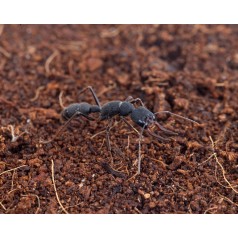
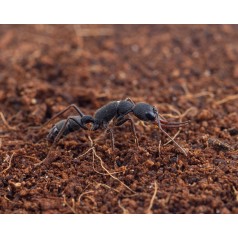
Large, powerful and territorial, Camponotus cruentatus stands out for its black and deep-red colouring and its enormous majors, with robust heads and powerful mandibles. In our experience observing this species, it is the most aggressive ant on the Iberian Peninsula, especially when a mature colony defends its territory.

In captivity it is hardy and easy to keep, although founding a colony requires patience. Young colonies grow slowly; with good feeding and warmth during the active season, development speeds up and increasingly large workers appear. Small colonies are usually much more timid than adults.

QUICK FACTS

  • Difficulty: easy, although colony founding is slow.

  • Colony founding: claustral and independent.

  • Social structure: the colonies offered by Anthouse have a single queen.

  • Queen: 15–16 mm.

  • Workers: 6–14 mm.

  • Mature colony size: several thousand workers.

  • Growth: slow initially; moderate once established.

  • Recommended temperature: 25–30 °C during the active season

  • Humidity: low to moderate, with large dry areas.

  • Winter rest: necessary; turn off heating during winter.
  • Diet: sugary liquids and insects.

BEHAVIOUR

It lives in the western Mediterranean, in warm, relatively dry habitats such as holm oak woods, pine forests and open areas. It usually nests underground or beneath large stones, which retain heat and encourage brood development.

Mature colonies vigorously defend their nest and food sources, especially aphids from which they collect honeydew. Majors venture out, patrol and confront other ants and insects using their mandibles and formic acid. They can also engage in fierce clashes with colonies of their own species.

It has no sting and can be managed with standard antkeeping tools. In captivity it is usually less combative than in the wild; hunting behaviour is easier to observe in large colonies, from approximately 200 individuals.

During the first year, having only a few workers is normal. As the population increases, growth accelerates and more developed majors appear. A mature colony can contain several thousand individuals.

The queen should start in a test tube, undisturbed and without forcing a move. With around 5 workers, the colony can be connected to a small founding nest, provided the available space suits its size.

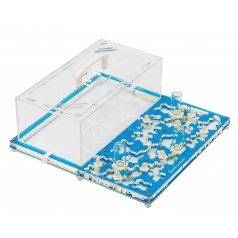
It can live in either QBIK ALPHA or QBIK WILD. A recommended option is the QBIK ONE 1C or QBIK ONE WILD 1C, together with a QBIK QUADRA foraging area. Both allow you to start small and expand as the population grows.

The ANTCRILIC and TERRA systems are also suitable, choosing an appropriate size or keeping unnecessary chambers closed.

The chambers must allow the queen and majors to move freely. Open new galleries or add modules when the available chambers are well occupied.

FEEDING

Sugary liquids are essential for supplying energy to the workers. In nature, much of this comes from honeydew produced by aphids and other hemipterans. In captivity, they should be supplemented with insects, which are needed to feed the larvae and support colony growth.

easy for even the first workers to eat.

  • Blue Sugar Nectar: one of the main ways to provide energy during the active season.
  • Anthouse Fruit Honey: an energy-rich food suitable for Camponotus; offer controlled drops or use a feeder.
  • Protein syrup: a supplement especially suitable for queens and young colonies, including after transport.
  • Silverfish (Thermobia domestica): very readily accepted; soft and easy for even the first workers to eat.
  • Crickets (Acheta domestica): highly nutritious and readily accepted; cut into pieces for small colonies.
  • Red Runner cockroaches: well accepted by medium and large colonies; nymphs suit young colonies.
  • Blaptica cockroaches: accepted when cut in half, providing plenty of protein per adult insect.

Mealworms and Zophobas are generally not readily accepted by this species.

A young colony can receive tiny drops of energy-rich liquids at least twice a week, along with small portions of insects. Adjust the quantity to the larvae and actual consumption, increasing it as the colony grows.

Offer fresh or thawed insects, opened or cut up when necessary to make the inside accessible. Remove leftovers before they spoil and always provide clean drinking water, even when the nest has a humidity source.

TEMPERATURE, HUMIDITY AND WINTER REST

During the active season it thrives between 25 and 30 °C, with particularly favourable growth between 28 and 30 °C. At lower room temperatures it can remain healthy, but will grow more slowly.

It needs low to moderate humidity, with sufficient dry space. You can keep one area moist and let the colony choose where to settle. It can also live with very little internal humidity, provided it has drinking water and a regular supply of energy-rich liquids in the foraging area.

Its winter rest must be respected. From late autumn, remove the heat source and allow temperatures to fall seasonally in a cool part of the home, avoiding frost. Reduce feeding according to activity while keeping water available.

Towards the end of winter, gradually restore warmth and regular feeding as the colony becomes active again.

COMMON MISTAKES

  • Expecting rapid growth during the first few months.

  • Moving the colony too early or giving it an excessively large nest.

  • Not providing enough warmth during the active season.

  • Neglecting sugary liquids or allowing drinking water to run out.

  • Offering only dry insects that are difficult to eat.

  • Keeping the entire nest saturated with moisture.

  • Skipping winter rest or leaving food scraps until they spoil.

IS THIS THE RIGHT SPECIES FOR YOU?

Camponotus cruentatus is ideal if you want a large, hardy Iberian ant with particularly impressive majors. Its size makes it easy to observe, and mature colonies display intense territorial activity.

Colony founding requires patience, but the wait is rewarded with workers of very different sizes and an increasingly active colony.

Best features: size, colouring, enormous majors and extremely aggressive territorial defence.

Main challenge: slow initial growth, the need for warmth during the active season and proper winter rest.

Anthouse
869 Items
New product
10ml Sugared water Food Anthouse 10ml Sugared water Food Anthouse 2
Available
Food

10ml Sugared water

Anthouse
€1.49
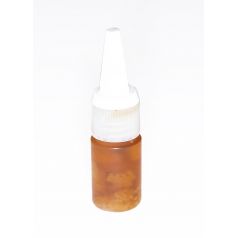
Contents: 10 mlThe product is a mixture of different types of honey and sugar.
250ml Water Gel Food Anthouse
Available
Food

250ml Water Gel

Anthouse
€2.99
Water gel that allows you to store a water reserve to our ants when we go travelling...
Trough with one hole. Other accessories Anthouse
Available
Other accessories

Trough with one hole.

Anthouse
€1.24
Size: 1.5 cm Essential to prevent dirt...

Customers who bought this product also bought:

Product added to wishlist